


Text updated: May 2026
The essentials to take on holiday are your documents, money, phone, charger, power bank, medication, toiletries, clothes suited to the weather, a hat, sunscreen, things for the children and some form of luggage protection. If you’re flying, it’s a good idea to pack an emergency kit for 1–2 days in your hand luggage: in 2024, 33.4 million bags were mishandled worldwide, which works out at 6.3 bags per 1,000 passengers.
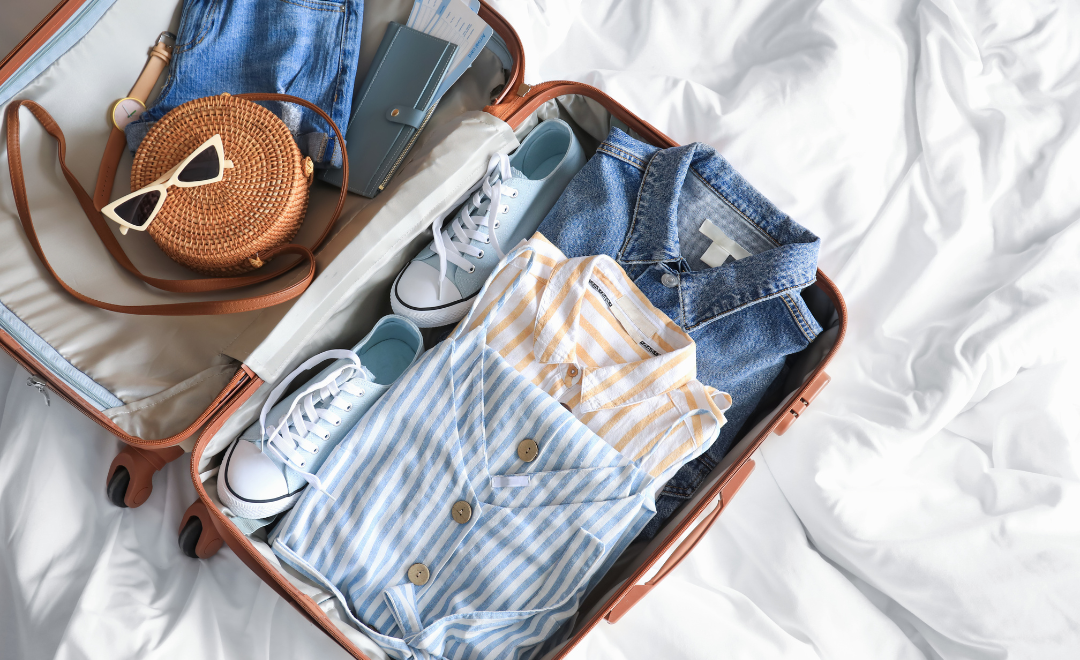
The best way to start packing is with a list. Split your things into categories: documents, money, electronics, clothes, toiletries, medication, things for the children, beach accessories and luggage protection. That makes it much easier to see what you really need and what would only take up space in your suitcase.

How to prepare for holiday packing
Start your packing with three things: checking your documents, the weather and the luggage rules. Only then move on to choosing clothes, toiletries and accessories.
First, check where you’re going and what documents you need. Packing for a weekend on the Polish coast is different from packing for a flight to Spain, and different again from a trip outside the European Union. For travel abroad, check the validity of your ID card or passport, the requirements of your destination country, your insurance and whether you need an EHIC card.
The second thing is the weather. It’s not just about daytime temperatures. Check the evenings, rainfall and wind too. In many places, 28°C during the day doesn’t rule out needing a hoodie in the evening, especially by the water or in the mountains.
The third thing is luggage. If you’re flying, check the size and weight limits for your suitcase. If you’re driving, the limit is more flexible, but it’s easy to overdo it and pack things nobody will touch for the whole trip.
How to write a good holiday packing list
A good holiday packing list should be divided into categories. That way you’re not throwing everything chaotically onto one sheet of paper – you can actually see what’s still missing.
The best way to divide the list is into:
- documents and money,
- electronics,
- clothes,
- toiletries,
- first-aid kit,
- things for the children,
- things for the beach or activities,
- food and snacks for the journey,
- luggage protection.
Put the most important things at the top. Documents, medication, phone, wallet, charger and tickets should be checked first. You can survive without a spare pair of shorts. Without a passport at the airport, not so much.

What documents to take on holiday
Take an identity document, a payment card, cash, your accommodation confirmation, tickets and insurance documents. If you’re travelling abroad, also check whether you need a passport, an EHIC card or a visa.
In your basic document pouch, pack:
- your ID card,
- your passport, if required or if you want a backup document,
- your driving licence,
- your EHIC card,
- your insurance policy,
- plane, train or coach tickets,
- your accommodation booking confirmation,
- a payment card,
- some cash,
- emergency numbers and your insurer’s contact details.
A practical rule: don’t keep everything in one place. If your wallet, documents and all your cash are together, losing one thing means a big problem. Keep some of the cash separately, and store copies of your documents on your phone or in the cloud.

What to take on holiday
Beyond documents, clothes and toiletries, it’s worth taking a few less obvious items that can save your trip in practical situations. The most useful are: a GPS tracker for your luggage, a laundry bag, an extension lead, a cable tie, a small torch, copies of your documents, a foldable bag, a mini first-aid kit and a quick-drying towel.
1. A GPS tracker for your luggage
A GPS tracker in your suitcase or backpack lets you check in the app where your luggage is. It’s especially useful on connecting flights, coach journeys, when suitcases are stored at the hotel or when you’re transporting more expensive equipment.
It doesn’t replace reporting lost luggage, but it gives you extra information. If your suitcase doesn’t appear on the carousel, you don’t have to just wait and guess where it is.
2. A foldable fabric bag
A foldable bag takes up very little space and comes in handy all the time: for shopping, the beach, dirty clothes, food, the children’s things or souvenirs bought before heading home.
Choose a lightweight bag that rolls up into a small pouch. In practice, a bag like this often saves the day when the suitcase is already full.
3. A laundry bag
Dirty clothes tossed loose into a suitcase quickly create chaos. A laundry bag keeps clean items separate from those that are used, wet or sandy.
It can be an ordinary fabric bag, a carrier bag or a zip-lock bag. The point is not to mix everything together in one compartment of the suitcase.
4. Zip-lock bags
Zip-lock bags are simple but incredibly practical. You can use them for toiletries, medication, cables, documents, a wet swimsuit, snacks or small items that easily get lost in a backpack.
They’re especially useful for toiletries. If something leaks, it won’t flood the whole suitcase.
5. A small document pouch
A document pouch helps you keep the most important things in one place, but not necessarily together with your whole wallet. You can keep your passport, EHIC card, tickets, bookings and emergency cash in it.
It’s also a good idea to keep some money somewhere else. If you lose your wallet, you’re not left with nothing.
6. Copies of your documents
Keep copies of your documents on your phone, in the cloud and optionally on paper. That means your ID card, passport, insurance policy, tickets and accommodation confirmation.
Copies don’t replace the originals, but they help you sort out the formalities faster if you lose something.
7. A small roll of tape
A small roll of tape can rescue a suitcase, a toiletry container, a damaged cable, a shoe that’s coming apart or a box with a souvenir inside.
It doesn’t have to be a big roll of repair tape. A small roll of strong tape is enough, ideally a flat one so it doesn’t take up space.
8. A carabiner
A carabiner is handy for clipping a bottle, cap, keys, pouch, small bag or lightweight tote to your backpack. It works particularly well on day trips, at the beach and when travelling with a child.
It’s a tiny thing that weighs almost nothing, yet often turns out to be useful.
9. A mini sewing kit
A mini sewing kit takes up less space than a pack of tissues, and it helps with a lost button, a split seam or a small tear.
It’s not essential for every trip, but on longer holidays it really does make sense.
10. Electrolyte sachets
Electrolytes are useful in the heat, on long journeys, with stomach problems or during intensive sightseeing. Sachets take up little space and are easy to slip into a toiletry bag or first-aid kit.
They’re a better choice than carrying big bottles of ready-made drinks.
11. A small cash reserve kept separately
Even if you mostly pay by card, it’s good to have a little cash kept separately. Not in your wallet, but in your pouch, backpack or a separate pocket of your suitcase, for example.
It’s an emergency backup for when the card terminal isn’t working, you lose your wallet or your card gets blocked.

Holiday checklist – what you need to bring
Not sure where to start packing? We’re here to help. Check out our holiday checklist, print it and gather everything you need for your trip. Remember that it’s a general list covering only standard travel items. Adapt it to your own needs, depending on where you’re going.
DOWNLOAD THE LIST HERE – print it and always keep it with you!
FAQ
Take your documents, money, phone, charger, medication, toiletries, clothes suited to the weather, sunscreen, a hat and comfortable shoes.
Pack your documents, wallet, phone, charger, power bank, medication, basic toiletries and a change of clothes in your hand luggage.
Yes, a GPS tracker is worth putting in your luggage because it lets you check the location of your suitcase, backpack or bag in the app.
The best place for a GPS tracker is inside the suitcase, in a less visible spot where it is protected from damage.
Protect your luggage by labelling the suitcase, adding the owner’s contact details, taking a photo of it before the trip and placing a GPS tracker inside.
Take your ID card, passport, driving licence, EHIC card, insurance policy, tickets and accommodation confirmation.
Leave behind new shoes, expensive jewellery, heavy books, too many clothes, full-size toiletries and anything without a specific use.
The things most often forgotten are chargers, medication, documents, glasses, a power bank, a plug adapter and everyday toiletries.

No Comments