Older people living with dementia or Alzheimer’s need safety and constant care. As a result of the illness, they can very easily put themselves in danger, or even get lost in a familiar neighbourhood. That’s why it’s worth investing in a tracker that will always help the carer establish where the older person in their care is. Find out how our device works and why else it’s worth having!
Dementia and Alzheimer’s – symptoms
With age, older people are at risk of developing conditions such as senile dementia or Alzheimer’s.
In the case of dementia, we’re dealing with cognitive decline caused by abnormal brain function. The illness makes logical thinking impossible, which leads to difficulties with basic everyday activities. Dementia changes a person mentally and physically: the sufferer may not remember where their own home is and may not recognise loved ones. The condition can occur in people aged 40–50, but it most often affects older people over the age of 65.
Alzheimer’s disease most commonly appears in people over 65, but it also occurs in younger people, including those who have been through traumatic events. It is the most common and irreversible form of dementia, affecting the memory, thinking and behaviour of the person affected. The symptoms of Alzheimer’s are very non-specific: they may include anxiety-related neurosis, behavioural disorders, depression and loss of short-term memory. Over time, these subtle symptoms become more severe.
In both cases, people affected by the illness will require appropriate care.
How to keep older people safe
Unfortunately, there are no effective medicines that could reverse the changes that have occurred in the brain or prevent the further progression of these conditions. Doctors use drugs that slow down or ease the course of the illness.
Nevertheless, an older person living with dementia or Alzheimer’s needs help and appropriate care that also focuses on their safety.
To achieve this, it’s best to create a friendly environment in their immediate surroundings – one that suits the needs of the person affected, allows them to maintain their independence and reinforces their personality.
To keep an older person affected by the illness safe, it’s worth securing the floors at home with rugs and fitting the walls with extra handrails and supports, which will reduce the risk of falls or slips.
It’s also worth investing in a tracker that allows you to monitor the location of a senior in real time – one who has gone out for a walk on their own and may have got lost. People with dementia or Alzheimer’s quite often slip out of the house on impulse, or prompted by a memory from decades ago, for example a feeling that they need to go to work, even though they haven’t been working for a long time.
Which tracker for a senior?
We recommend choosing a discreet, small tracker that can be hidden in various places, or that the senior can wear as a special wristband.
Modern devices work using GPS or Bluetooth and send location information to the phone of the person caring for the older adult. This is very important, because it allows the senior’s location to be monitored at any time and from anywhere.
An additional criterion when choosing a tracker should be the ability to set safe zones, so that the carer receives a notification on their phone when the boundary is crossed.
How does the notiOne tracker for seniors work?
The notiOne go! PLUS device works using Bluetooth technology, yet it can still find people and items even at the other end of Poland. All thanks to a network of phones with partner apps, used by 5 million users.
The signal from the tracker is picked up by phones running the notiOne app and partner apps. It is then sent to a server, which determines who the device belongs to. In this way, the older person’s location appears on the map in the carer’s phone. It all happens very quickly.
The notiOne GPS tracker for an older person uses satellite data to determine its position. This solution guarantees control over the location even when there’s no phone nearby. On top of that, it works in 110 countries, and its lightweight design makes it easy to mount, for example on parts of a wheelchair. The device will also easily fit into a bag, bum bag or backpack.
The out-of-range alarm in the notiOne tracker
An extra feature of the notiOne go! PLUS tracker is the out-of-range alarm, which you’ll find in the app. When the tracker leaves the Bluetooth range, i.e. moves around 90 metres away from the phone, the owner receives an audible notification on their smartphone. The feature supports the care of older people, including at home, from which those affected by the illness often slip away on impulse or in a sudden surge of independence.
Where to attach a tracker for an older person
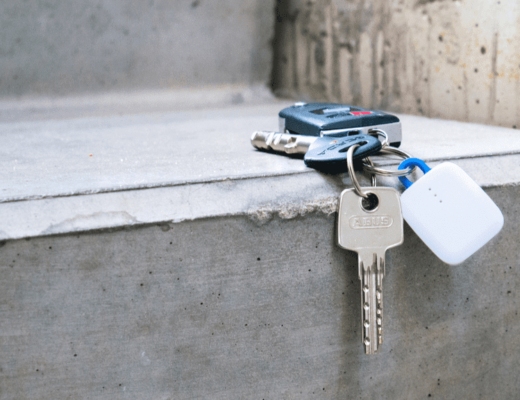
The notiOne go! PLUS tracker can be attached to keys, parts of a wheelchair, a walking stick, or even the zip of an older person’s jacket. There are plenty of options. An older woman can keep the tracker in her handbag, while an older man can attach it to his belt.
The notiOne GPS tracker, in turn, will also fit into a handbag or backpack. Thanks to its durable, compact design, it works brilliantly attached to parts of a wheelchair.

How much does a tracker for a senior cost?
If you choose the notiOne go! PLUS tracker, you’ll pay PLN 119, while notiOne GPS costs PLN 489.
Both trackers are waterproof and made from very durable materials that will withstand minor mechanical damage as well as rain and other weather conditions.
notiOne Bluetooth trackers run for up to a year on a single battery, so you don’t have to worry about replacing it any time soon. The GPS lasts up to 2 months on a single charge.