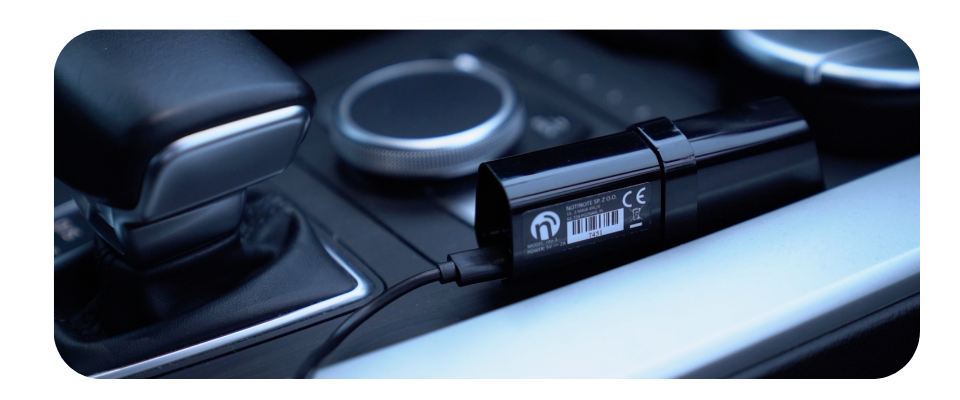
Increasingly popular with both private and business users, GPS trackers effectively track a car’s position and protect it against possible theft. In 2026 alone, 5,327 passenger cars and vans were deregistered in Poland due to theft, and the year before the figure was 5,646 cars. Notably, as many as 40% of all thefts in the first half of 2025 were recorded in the Masovian Voivodeship alone.
These figures confirm that interest in search phrases such as “GPS tracker for a car”, “car GPS with no subscription”, “GPS transmitter for a vehicle” keeps growing. Wondering which car GPS tracker to choose and how the available models differ? These are exactly the questions that come up most often before a purchase. Below we explain how the different types of trackers work and which solution will serve you best.
What is a GPS tracker? (2026 update)
A GPS tracker is a device that lets you determine the position of people, objects and vehicles to within a few metres. It is fitted with a GPS receiver that picks up signals from satellites orbiting the Earth, while data is still transmitted to the app via a GSM/LTE module.

In recent years manufacturers have also introduced solutions based on more energy-efficient transmission standards such as LTE-M and NB-IoT, which allow trackers to run more reliably and for longer on a single charge.
The geographic coordinates obtained are processed by the manufacturer’s server and presented to the user in the mobile app as an easy-to-read map, a location history and security alerts.
Does a GPS tracker need a SIM card?
A SIM card is an essential part of any tracker fitted with a GSM data transmission module. This comes down to how the telecommunications infrastructure is built: it requires this extra component for authorisation (logging in). This is how the operator receives information from the GSM module inside the tracker. It knows who is logging in to its network and can charge for data transmission accordingly.
In 2024–2025 interest in choosing the right GPS tracker for a car grew significantly, and interest in devices that don’t require you to manage a SIM card yourself rose by around 38% year on year. The most common searches are: “GPS tracker without a SIM card”, “GPS with no subscription”, “car tracker with no subscription”. This shows a clear trend: users prefer solutions that involve neither SIM card handling nor recurring costs.

Trackers with a subscription or your own SIM card
A large proportion of GPS trackers require you to install your own SIM card, which is a hassle for the user. It usually also means having to register the card, carry out additional configuration and keep the data packages topped up. Worse still, users often get no notification that the SIM card has expired or that it has run out of the data allowance needed to send the device’s position. This carries the risk that the tracker will stop working at the least expected moment.
There is also a group of devices with a built-in SIM card that nonetheless require additional recurring payments. It’s certainly very convenient – the manufacturer takes care of data transmission. Unfortunately, it can put a noticeable strain on the household budget. Looking at the offers on the market, the annual subscription can exceed the price of the tracker itself. Here too, it can happen that at some random moment, instead of the position of your stolen vehicle, the app shows you a notification that the period you paid for has just come to an end.
An analysis of market offers shows that the real cost of running a subscription-based tracker for 3 years is PLN 700–1,200, which is often 2–3 times the price of the device itself. What’s more, service-request statistics show that as many as 27% of faults are caused by SIM card problems – most often an expired data package.
Which car GPS tracker is the most convenient in practice?
A notable exception is notiOne GPS devices, which have a built-in SIM card you never need to worry about, because it comes with no extra fees. How is that possible? In this case the manufacturer has heavily optimised everything to do with data processing and included it in the price of the tracker itself. As you can easily see, this is the most convenient option of all – access to the location in every situation, without worrying whether the device has what it needs to transmit data.
How much does a subscription-based tracker cost?
Prices for subscription-based trackers start from as little as PLN 199. Although the price looks very attractive at first glance, you quickly realise that using the device won’t be cheap. Why? Precisely because of the subscription mentioned in the title, which over a 12-month period often comes to as much as 3 times the price of the tracker. That’s why it pays to analyse the manufacturer’s offer carefully before buying, to avoid disappointment.

How much does a GPS tracker with a built-in SIM card and no extra subscription cost?
Prices for this kind of solution start from as little as PLN 399 – notiOne GPS.
For that price, the user gets a position update every few minutes, access to a 30-day location history, and the option to choose one country (e.g. Poland) in which the tracker operates.
For a slightly higher one-off payment of PLN 599, you can get a real powerhouse – notiOne GPS PLUS. This tracker offers a full 90 days of location history, a configurable position update frequency (as often as every 10 seconds), roaming across the whole of Europe, e-TOLL support (Poland’s electronic toll system) and a notification when the tracker starts moving (anti-theft alert).
In each of these cases the manufacturer charges no additional fees, whether you use the device for a few months or for several years.